
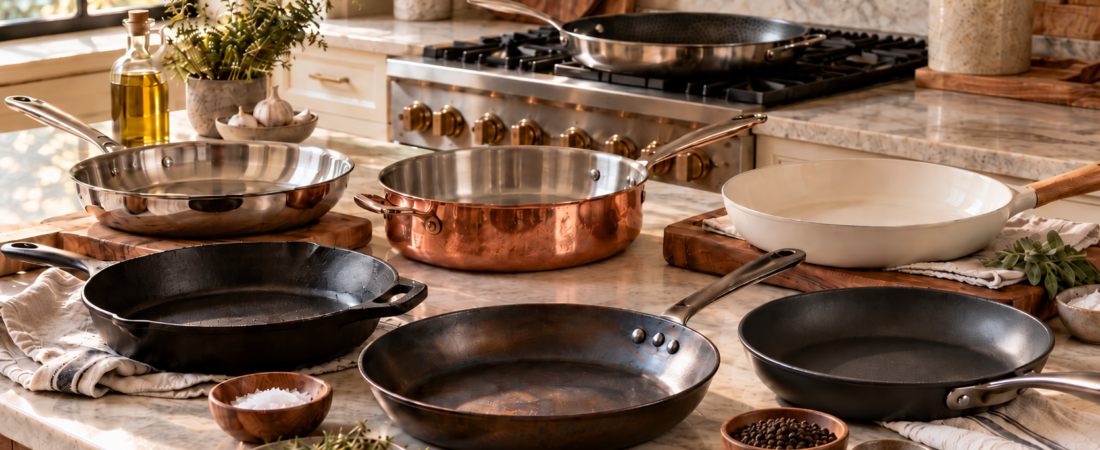
The Pan You Reach for Matters More Than You Think: The Art of choosing the right pan.
Can one pan fulfill all your culinary needs?
Is there a type of cooking pan that can do everything? Something dependable enough for morning eggs, a quick pasta sauce, and a beautifully seared steak at dinner.
Modern cookware often promises just that, and to be fair, many pans can do several jobs quite well.
But great cooking is more about the dish than every minute detail you have to worry about in-between.
Yet the difference between a good meal an exceptional one sometimes begins with the pan.
A delicate omelet needs something very different from a deeply browned steak. A tomato sauce asks something different of a pan than a piece of crisp-skinned salmon.
There is no a pan out the that is the answer to all of our culinary problems, there’s simply just the best pan for the job.
Start With the Food, Not the Pan
I have watched people try to sear steak in a traditional nonstick skillet. To get the deep brown crust they wanted, they kept turning up the heat. Eventually, the inside of the pan showed signs of scorching and wear.
The problem wasn’t the cook. It was the tool.
They had the right temperture, the righ cut just not the right pan, and that matters.
A $50 piece of steak cooked in the wrong pan is not forgiving as you think.
A steak benefits from a pan that handles high heat well. Stainless steel, cast iron, and carbon steel are all excellent choices. They tolerate higher cooking temperatures and provide the conditions needed for effective browning.
Nonstick has its own talents. Eggs are an obvious example. So are pancakes, crêpes, and other delicate foods that release more easily from a slick surface.
But, steak. I would reconsider.
Using the right pan makes cooking easier. It can also make the food tastes great.
With the right pan, you can make an inexpensive cut of meat, turning to fine dining. While on the other hand, Cooking steak with the wrong methods and the wrong pan, your better of ordering takeout.
Why the Material Matters
The material and construction of cookware influence how quickly it heats, how evenly warmth spreads across the cooking surface, and how readily it responds when the burner temperature changes.
Those differences show up on the plate.
A pan that holds heat well can help create a dark crust on a steak. A more responsive pan gives you greater control over a delicate sauce.
This is why professional kitchens rarely depend on one kind of cookware.
Construction matters as much as the material itself.
Many stainless-steel pans incorporate aluminum or copper because stainless steel alone conducts heat relatively poorly. A fully clad pan extends those conductive layers through its sides, while a disc-bottom design concentrates them beneath the cooking surface.
Thickness also affects performance. A heavier, well-constructed pan often distributes heat more evenly, though it may take longer to respond when the temperature changes.
Understanding these distinctions makes it easier to choose cookware for performance rather than appearance or claims.
Stainless Steel: The Everyday Essential
For many cooks, a good stainless-steel skillet is one of the most useful pans to own.
It performs particularly well when browning meat, sautéing vegetables, or preparing a pan sauce. As food browns, flavorful deposits called fond develop on the cooking surface. Adding stock, wine, or another suitable liquid loosens those browned bits, creating a concentrated foundation for sauces.
Quality stainless-steel cookware can remain useful for decades with proper care.
Its weakness is equally familiar: food can stick if your not familiar with a stainless-steel.
The solution often comes down to technique. Give the pan time to preheat, add your cooking fat, then give the food time to form a crust before trying to move it. The last part is where patience will win.
Best for: Searing, sautéing, browning, pan sauces, chicken, steak, and vegetables.
Care: Allow the pan to cool before washing. Avoid sudden temperature changes that could cause warping. Soaking and cleaners formulated for stainless steel can help remove stubborn residue
Cast Iron: For Deep Browning and Sustained Heat
Cast iron is valued for its substantial weight and ability to retain heat. Although it takes time to warm thoroughly, a properly preheated skillet offers a dependable cooking surface for steak, burgers, cornbread, and shallow frying.
That makes it a natural choice for steak, burgers, cornbread, shallow frying, and foods that benefit from a strong, steady cooking surface.
This is my favorite go-to for burgers when I do not want to grill out side on a rainy day. Some of my best burgers are cooked on a cast iron.
Frying fish or chicken is its specialty, why because when you are frying food at high heat You need the food to be able to cook evenly and thoroughly. And you can only do that with a pan that can sustain even heat throughout the cooking process.
Its usefulness extends beyond the stovetop. An oven-safe cast-iron skillet can move directly into the oven, making it especially practical for dishes that begin with searing and finish with roasting.
Cast iron is not without limitations. Real cast iron pans are heavy, many people have to use both hands to handle the pan. Traditional cast iron needs seasoning, which means maintaining a thin layer of baked-on oil that helps protect the pan and improve its cooking surface. The last limitation is that although it retains and sustained heats very well it does not respond well to rapid temperature changes in heat, not one of the best choices for cooking delicate recipes.
Yes, cast iron does need a little maintenance and know how to keep it seasoned and but the pay off is good. Powerhouse roasting and high heat cooking.
Best for: Steak, burgers, cornbread, shallow frying, roasting, and high-temperature cooking.
Care: Keep it dry. Wash it without prolonged soaking, dry it thoroughly, and add a very thin coat of oil when needed. Rust is usually a moisture problem, cast iron can still occasionally rust, but can be usually removed and the surface restored if caught and treated early.
Carbon Steel: Cast Iron’s Lighter Cousin
Carbon steel shares many of cast iron’s cooking characteristics but generally comes in a thinner, lighter construction.
It heats faster and responds more quickly when you adjust the burner. With regular seasoning, its surface also becomes increasingly slick.
This makes carbon steel especially appealing for cooks who regularly prepare steaks, vegetables, eggs, and certain fish dishes.
Like traditional cast iron, however, it requires maintenance. Its seasoning can be affected by prolonged cooking with acidic ingredients, and the pan must be dried properly to prevent rust.
For cooks who appreciate cast iron’s versatility but prefer something easier to lift and maneuver, carbon steel deserves consideration.
Best for: Searing, sautéing, vegetables, eggs, and stovetop-to-oven cooking.
Care: Keep the surface seasoned and dry. Avoid leaving acidic foods, such as tomato sauce, in the pan for long periods because they can weaken the seasoning. Particularly while the seasoning is still developing.
Traditional Nonstick: A Specialist, Not a Workhorse
A good nonstick skillet makes certain jobs wonderfully easy, like everyday cooking.
Eggs slide out with little effort. Delicate fish is easier to turn. Pancakes need less fat. Cleanup usually takes only a moment.
Its limitations become apparent at higher temperatures.
Traditional PTFE-based nonstick coatings are designed for controlled cooking rather than prolonged high-heat searing.
Overheating can damage the coating and, at sufficiently high temperatures, cause it to degrade and release fumes.
Concerns often center on PFAS, a large family of chemicals that includes PTFE, the material traditionally used in many nonstick coatings. The subject deserves more nuance than social media often gives it.
The U.S. FDA says the PFAS used in authorized nonstick cookware coatings are tightly bound during manufacturing. Its current data show negligible amounts capable of migrating into food. Other health authorities also say PTFE cookware is not expected to harm consumers when used as intended.
The important part is used as intended.
Don’t leave an empty traditional nonstick pan over high heat. Health Canada recommends avoiding high heat above about 500°F, while Germany’s Federal Institute for Risk Assessment warns that PTFE can begin breaking down at much higher temperatures around 360°C, or 680°F.
In everyday terms: your nonstick pan does not need to become blazing hot.
Best for: Eggs, omelets, pancakes, crêpes, delicate fish, and gentle reheating.
Care: Generally use low to medium heat and avoid preheating an empty pan for extended periods. Follow the manufacturer’s utensil and cleaning recommendations. Replace cookware with a significantly damaged or deteriorating coating.
Ceramic-Coated: Easy Release Without Traditional PTFE
Ceramic-coated nonstick cookware is often marketed as an alternative to traditional PTFE coatings.
These pans typically use a coating based on silica-derived materials rather than a conventional fluoropolymer nonstick surface. When new, they can offer excellent release for eggs, pancakes, and other delicate foods.
Their weakness is durability and longevity. The slick quality can fade, especially after repeated high-heat cooking or rough cleaning.
Ceramic-coated cookware should also be distinguished from solid ceramic cookware. A ceramic-coated skillet is generally a metal pan with a thin nonstick coating, not a pan made entirely of ceramic.
For cooks seeking a PTFE-free nonstick surface, ceramic-coated cookware offers a practical option, provided expectations about its useful life remain realistic.
Best for: Eggs, gentle sautéing, pancakes, everyday lower-heat cooking.
Care: Avoid excessive heat and abrasive cleaning unless specifically permitted by the manufacturer. Use appropriate utensils to protect the coating.
Copper: Precision and Temperature Control
Copper has long been appreciated in kitchens where precise temperature control matters.
Turn the heat up, and it responds. Lower the flame, and it cools more quickly than heavy cast iron.
Its exceptional thermal conductivity allows heat to spread quickly and evenly, while adjustments at the burner can produce relatively rapid changes in cooking temperature.
These qualities make copper particularly useful for sauces, reductions, and delicate preparations where control is essential.
Most modern copper cookware incorporates a stainless-steel lining, while some traditional pieces use tin. The lining matters because unlined copper can react with acidic foods, and tin-lined cookware requires particular attention to temperature limits.
It is beautiful cookware, but it asks for more maintenance and usually comes at a higher price. It is considered a specialized investment rather than a necessity for most home kitchens.
Best for: Sauces, delicate cooking, temperature control.
Care: Follow the instructions for the lining inside the pan. The copper exterior will naturally develop a patina. Polish it only if you prefer the brighter finish.
Hybrid Cookware: The New kid on the block
Hybrid pans combine different materials or surfaces to capture benefits from more than one style of cookware.
HexClad is one well-known example. Its current hybrid line uses raised stainless-steel areas over a ceramic nonstick surface, with an aluminum core inside the pan. The company says its current TerraBond coating is made without PTFE or PFAS.
This kind of cookware can give a home cook more versatility from fewer pieces.
However, combining features does not eliminate their limitations. A conventional stainless-steel skillet may still be preferable for developing fond, while a smooth nonstick surface may be easier for preparing delicate eggs.
Versatility is valuable, but specialization still has its place.
Best for: Everyday cooking when versatility and limited cookware storage are priorities.
Care: Follow the specific manufacturer’s guidance. Heat limits, utensil compatibility, and maintenance requirements depend on the construction and coating.
Glass and Glass-Ceramic Cookware: A Different Kind of Tool
Glass cookware is more common in baking dishes and casseroles than in frying pans.
Its great advantage is visibility. You can see browning and bubbling through the sides. It also does not react with acidic foods.
But glass is not the first choice for hard stovetop searing. Some glass-ceramic cookware is designed for burners, while ordinary glass bakeware is not.
This Is another favorite that I have in the kitchen it is great for soups and stews. One thing I like about it is that it can handle acidic foods like tomato sauce. a disclaimer is that certain glass-ceramic products are engineered for burner use, but they should not be confused with conventional oven-safe glass. Glass cookware also Has a slow response to fluctuating temperature adjustments, it’s slow to heat, and can be slow to cool.
Best for: Casseroles, baked pasta, roasting, and oven dishes, For oven safe cookware. And for stove top safe cookware, soups, stews, slow braises.
Care: Always confirm whether the cookware is approved for stovetop and or oven use. Avoid sudden temperature changes and follow the manufacturer’s handling instructions.
Beyond the Material: Three Details Worth Considering
Before purchasing a pan, consider three practical characteristics that can be just as important as its material.
The cooking surface. A skillet with a generous flat base provides more room for ingredients to brown without overcrowding. Sloped sides make tossing and turning easier, while higher, straighter sides help contain liquids and sauces.
The handle and weight. A pan should feel balanced and manageable when filled with food. Heavy cookware can be excellent for certain techniques, but it offers little advantage if its weight makes everyday cooking difficult.
The stovetop. Not every pan works on every cooking surface. Induction burners require compatible magnetic cookware, while glass-top ranges benefit from smooth, stable bases that sit flat against the surface. Always check compatibility before purchasing.
An expensive pan with the wrong proportions or construction may be less useful than a modestly priced one thoughtfully chosen for the way you cook.
So, How Many Pans Do You Really Need?
Probably fewer than the average cookware aisle suggests.
A thoughtfully assembled cookware collection does not need to be extensive.
For many households, three complementary skillets provide considerable flexibility:
- A 10- or 12-inch stainless-steel skillet for everyday sautéing, browning, and pan sauces.
- A cast-iron or carbon-steel skillet for high-temperature cooking and dishes that benefit from a substantial cooking surface.
- An 8- or 10-inch nonstick skillet for eggs and other delicate preparations.
These are useful starting points rather than a universal shopping list. A cook who rarely sears meat may have little reason to maintain a separate cast-iron skillet. Someone who routinely prepares braises and soups may benefit more from a Dutch oven or a heavy-bottomed saucepan.
Choose additional pieces only when your cooking habits justify them.
Knowing When to Replace a Pan
Durability varies considerably between cookware materials.
A stainless-steel skillet with surface discoloration may need nothing more than a thorough cleaning. Rusted cast iron can often be restored. A carbon-steel pan with damaged seasoning may simply need to be cleaned and seasoned again.
Coated cookware is different. Once its cooking surface has substantially deteriorated, restoring its original nonstick performance is generally not practical.
A severely warped base can also compromise cooking performance and stovetop contact, particularly on flat cooking surfaces.
Knowing when cookware can be restored and when replacement is appropriate helps prevent unnecessary purchases without compromising performance.
The most useful cookware collection is not necessarily the largest or most expensive. It is the one that reflects what you cook, how you cook, and the results you want to achieve.
The next time you reach for a pan, consider the food first. The right choice may already be in your cabinet.
Leave a Reply